Public & third sector training
Helping organisations strengthen human interactions where it matters most.
Public and third sector organisations operate under scrutiny, tight budgets and complex need. The interactions your teams have with residents, patients, tenants, students and communities shape trust, safety and outcomes.
As AI reshapes how people access information, the human skills it can’t replicate become even more valuable: listening, empathy, sound judgement, clear decision making and calm de escalation.
Take Effect Training closes people skills capability gaps quickly through practical, scenario based learning that fits your policies, values and service standards.
Strengthen service outcomes

Build capability where service outcomes matter
As public expectations evolve, the skills that build trust, uncover need and guide decisions become the differentiator.
In public and third sector environments, every interaction can influence safety, satisfaction and reputation especially in contact centres, frontline visits and sensitive case discussions.
We flex to your environment aligning language, scenarios and standards to your policies so learning transfers into live service.
You leave with practical frameworks, shared approaches and applied practice that embeds behaviour change through “learning by doing”.
We connect learning directly to measures that matter: customer satisfaction, complaint handling, staff confidence, quality conversations and Social Return on Investment—engaging leaders so improvements show up quickly where it counts.

Service conversations need to show up in live interactions — on calls, in visits and in team discussions. Your people will build practical confidence in the moments that shape outcomes:
Through long term partnership, you gain more than a training course; you gain a partner who understands public service realities—enabling more consistent service and stronger stakeholder relationships.
People skills you can rely on—built for public service
Working with Take Effect means people skills development you can rely on: relevant, adaptable, aligned to your service goals—and delivered by a partner who evolves with your operating needs.
Expect practical tools, applied practice, and targeted feedback that accelerates performance.
We make capability stick through a blended approach: live simulations, experiential practice, public service case studies, peer learning, micro learning—strengthened by AI supported prompts and nudges that reinforce behaviour.
Whether building core customer experience skills or strengthening management conversations, we flex every programme to your context.
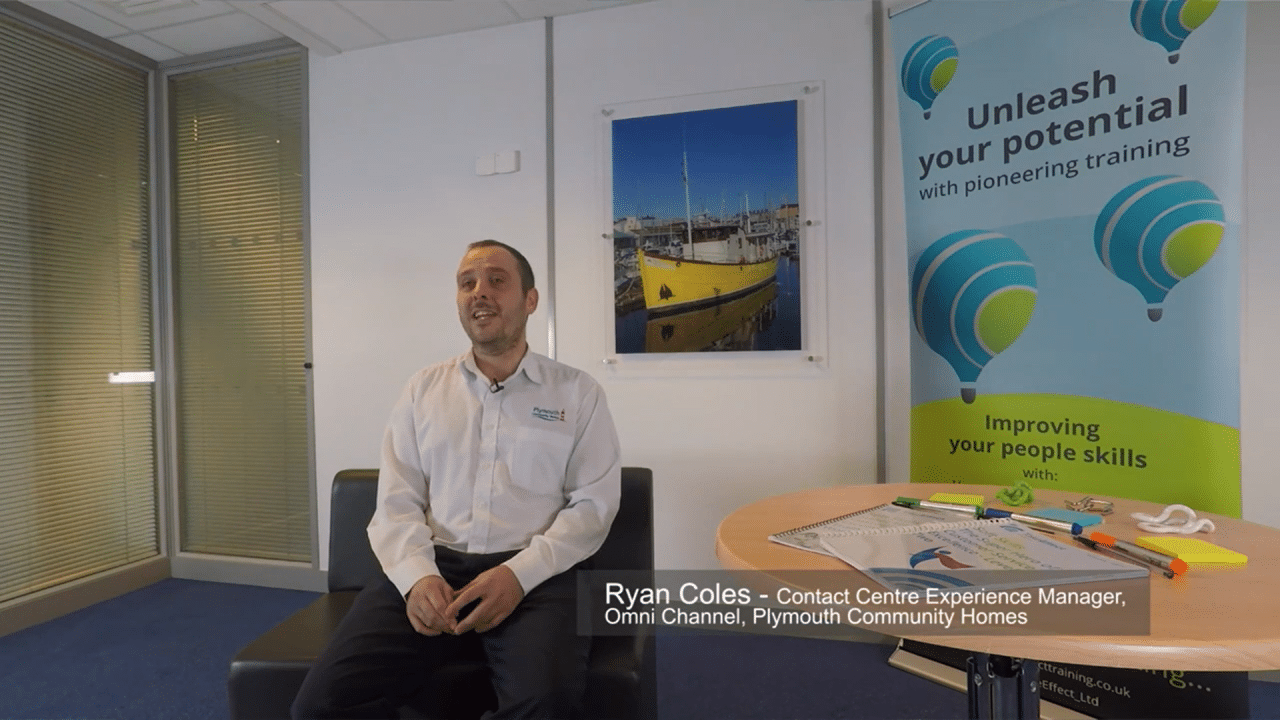
Results, in our clients’ own words
After a tailored training programme with Take Effect, Plymouth Community Homes experienced significant performance improvement and increased customer NPS scores. This culminated in PCH being awarded the prestigious Customer Service Excellence accreditation. Hear how focused preparation and applied practice made the difference.
How we take effect
Learning that sticks
Most training fades quickly. Ours is designed to last. We move beyond passive learning by combining structured practice, experiential learning, coaching, peer learning and AI-enabled behavioural prompts that reinforce service habits in real conversations.
This layered approach ensures skills are understood and applied consistently in live interactions—driving measurable behaviour change, stronger service consistency and tangible results.
Flex to your needs
Our programmes are expertly designed and never generic, tailored to your audience, service standards and operating realities for immediate relevance.
Choose live simulations with professional role players, adaptable group sizes, formats and durations.
Delivered at your site or ours, our blended approach integrates human-led sessions with AI-enabled reinforcement, sustaining behaviour change between sessions and ensuring skills are applied before, during and after real interactions.
Learning through doing
AI can provide information, but public service depends on navigating emotion, ambiguity, vulnerability and risk in real time. That’s why we prioritise scenario-based practice. Sessions are immersive and built for frontline reality: purposeful practice, realistic conversations and structured feedback that accelerates skill development. Learning through doing ensures stronger retention and seamless transfer into day‑to‑day service from day one.
Ultimately relevant
Relevance drives engagement—and engagement drives better outcomes. We take time to understand your service users, your pressures and your constraints. We design scenarios that mirror the conversations your teams face, from early enquiries through to complaints, conflict and resolution. This makes learning immediately applicable, increasing confidence and enabling your people to perform where outcomes are won or lost.
Neuroscience & psychology
Our approach draws on behavioural science, workplace psychology and decision-making research. We design learning that reflects how people think, respond and commit under pressure. From spacing and reinforcement to emotional engagement and habit formation, every element is intentional—ensuring your investment translates into consistent application and stronger service interactions.
Deep expertise
We bring extensive expertise to every programme, combining decades of experience in learning, development and third sector environments. We’ve supported organisations across Housing Associations, the NHS and wider public and third sector and more. We understand complex customer needs and multi-stakeholder priorities, and have developed people at every level from phone-based advisors to senior leaders.

The organisational impact of a people skills gap
When people skills are underdeveloped, service outcomes suffer.
The impact
Teams face pressure from complex needs, high emotional load, increasing demand and constant scrutiny without consistent frameworks to navigate interactions effectively.
The outcomes are predictable: customers feel unheard, complaints escalate, conflict increases and staff confidence drops.
Also, handovers become inconsistent, expectations are missed, and trust weakens. Absence and attrition rise when pressure meets poor conversational support.

The solution
People skills are not “soft”—they are structured, learnable behaviours that improve with tools, practice and reinforcement in realistic scenarios.
They develop through repetition, feedback and accountability.
Because public outcomes depend on interactions, the quality of listening, clarity, boundary-setting and de escalation has a direct, measurable impact on satisfaction, resolution rates and service reputation.
We supercharge your learning with a ready-to-go training programme that can cover:
Practical training for the conversations that determine service success.
Your people will create better experiences — with residents, patients, tenants, service users and colleagues. They will uncover need more effectively, communicate decisions clearly, handle conflict early and influence outcomes with confidence. You’ll see stronger satisfaction, fewer escalations, faster resolution and more consistent service standards.
Our programmes focus on practical application, confident communication and lasting behaviour change to support your managers and teams to communicate more effectively . Workplace situations can include,
Outcome focused facilitation that shifts performance.
At Take Effect Training, we understand that impact depends on who delivers it. Our facilitators combine real world service experience with behavioural expertise, bridging the gap between organisational standards and the behaviours that drive them — trust, influence, listening and credibility.
An external facilitator brings energy, objectivity and challenge. We create practice-led environments where people rehearse critical conversations safely, building confidence and capability that transfers directly into live service.
The result: stronger engagement, consistent behavioural change and measurable impact.

Track progress and strengthen performance
We believe people skills capability should be measured through real outcomes, not feedback alone.
Tracking progress
We define success upfront (e.g., quality of listening, expectation-setting, de escalation, clarity of decisions, complaint handling and confidence), then track progress through structured observation, feedback and workplace performance indicators.
Objective data
Assessment options—such as 360 degree feedback, observation, quality scoring and scenario performance—giving clear evidence of what’s improving and where coaching is needed.

In the flow of work
Like many organisations you can now choose our add AI-powered add-on “in-the-flow-of-work” tools to keep learning alive between sessions. It sends timely knowledge refreshers and behavioural prompts that encourage people to apply new habits in real situations.
Meaningful outcomes
We support integration into your systems, linking capability development to satisfaction, resolution, retention and service outcomes.
Why Take Effect Training
Public and third sector interactions must perform in the moments that matter: early contact, sensitive conversations, complaints, conflict and resolution — while balancing policy, fairness and empathy.
Our programmes are built around outcomes: clearer communication, stronger listening, improved influence, more consistent decisions and calmer conflict management — resulting in better experiences, stronger trust and improved service performance.
Flexible delivery & formats
One size doesn’t fit all. Choose in‑house training, virtual delivery, or a blended programme spaced over time, so your people can practise, apply, reflect, and refine their skills, embedding learning and transferring to the workplace.
Flex options (ready-to-go)
The power of workplace simulations
Mastery comes from practice. Workplace simulations allow your people to test approaches, receive feedback and refine technique—ensuring behaviour improves in real interactions with the public.
The workplace simulations that we offer are superior to using an AI avatar as we are replicating complex human interactions. Human role players replicate real stakeholder dynamics, emotional nuance and complex objections far beyond AI-only simulations.
We can integrate AI into selected parts of your training programme, such as knowledge checkers and follow-up booster sessions, whereas our expert human facilitators and role players lead the core training. This is what differentiates Take Effect from many leadership training companies — and strengthens people skills capability across your organisation.


Partner with us.
How it works in four easy steps.
Step 1. Quick discovery process
Start with what matters: who you’re developing, what success looks like, and your timelines.
Then we recommend the right programme and format, ensuring the approach fits your constraints, priorities, and pace of delivery.
Step 2. Tailor to your world
Shaped to your context: we capture your real people challenges, language and priorities, then tailor the course to reflect your values and ways of working, using relevant scenarios and examples that ensure the learning feels practical, relevant, and immediately transferable.
Step 3. Choose your flex options
Select what will make it land: group size (typically 6–16), session length (half‑day to multiple day, deep dive), venue (your site or ours), workplace simulations with human role players, Forum Theatre for larger groups, plus optional AI-led booster prompts/checks to embed learning.
Step 4. Deliver, embed, measure
Make it stick in practice: we deliver the sessions, drive application and behaviour change, and support transfer into the workplace through simple reinforcement, while giving you clear measures of impact so you can see progress, track change, and evidence results.
Common queries about our public & 3rd sector programmes
If your question isn’t answered below, get in touch with us.