Customer Service
Exceptional service isn’t accidental—it’s trained, tested, and practised.
AI is a welcome addition for handling basic customer enquiries. But technology can’t mend broken trust. With a single click, a customer’s opinion of you can go viral—so trust becomes the differentiator that wins new customers and keeps them.
That’s why effective communication isn’t “just common sense”. It’s a learnable, repeatable skill, especially when the stakes are high: complaints, vulnerable customers, service recovery, policy boundaries, billing disputes, delivery failures, and emotionally charged conversations.
Take Effect Training closes customer-service skill gaps quickly, so your teams don’t just respond faster, they respond better.
Unleash their potential

Build capability where it counts most
Customer service has evolved faster than most training, with customers expecting speed and convenience—yet judging you on human moments: clarity, fairness, and how you make them feel when things go wrong.
A study by Salesforce found that as AI grows, trust matters even more: 61% say it increases the need for trust, and 72% want to know if they’re speaking to AI.
To improve CSAT, NPS and complaint outcomes, you need behaviour change—not awareness. We train teams to handle complex, high‑stakes conversations with confidence and consistency, tailoring content to your culture so skills transfer into day‑to‑day work.
You gain practical tools, measurable results, and a long‑term partner who drives faster execution, stronger performance, and better retention.
As a long-term partner, you gain deep expertise, continuity across cohorts, and growing knowledge of your operation — leading to stronger day-to-day performance and more reliable results.

Customer service skills must show up in real time—on calls, in chats, and across everyday customer interactions, often under pressure. Your teams will build practical confidence where it matters most:
Customer-service skills training you can trust—designed for today, built for what’s next
Working with Take Effect means customer-service development that’s relevant, flexible, built around your goals—and delivered by a partner who stays alongside you as needs evolve.
We make learning stick through a blended approach: workplace simulation, experiential practice, relevant service casework, social learning, micro‑learning—reinforced by optional AI-assisted behavioural prompts and reminders that support application before, during and after the programme.
Whether you’re building everyday service habits or sharpening advanced de‑escalation and complaint-handling skills, we tailor every programme to your context. Expect real-world tools, purposeful practice, and feedback that helps people improve fast.
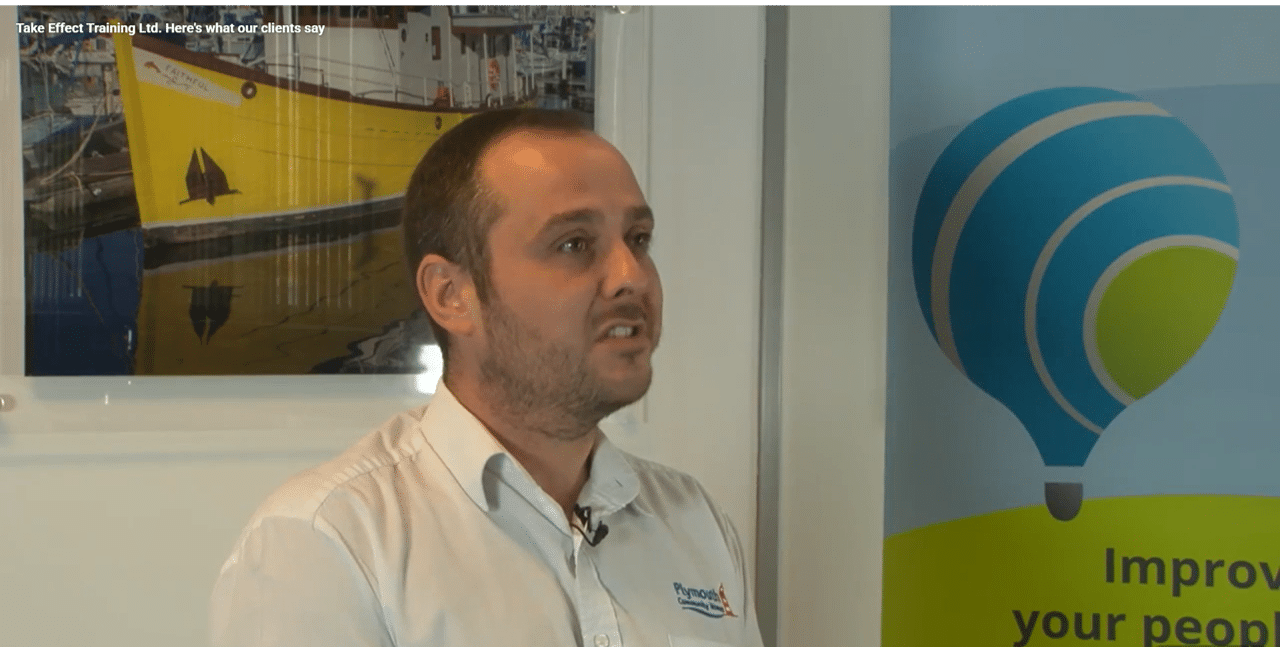
Results, in our clients’ own words
After a tailored training programme with Take Effect, Plymouth Community Homes experienced significant performance improvement and increased customer NPS scores. This culminated in PCH being awarded the prestigious Customer Service Excellence accreditation. Hear how focused preparation and applied practice made the difference.
How we take effect
Learning that sticks
Most training fades fast. Ours is designed for service floors and contact centres. We blend simulation, coached practice, peer learning and short digital nudges so habits show up in live tickets, calls and chats.
The result: calmer responses, consistent language, and measurable shifts in CSAT and repeat contacts.
Flex to your needs
No two service operations are the same. We tailor tone, scenarios and tools to your customers, channels and policies. Choose in-person, virtual or blended delivery, with sizes that fit shift patterns.
Human-led sessions are reinforced with simple AI-enabled prompts between workshops to keep behaviours active across busy weeks.
Learning through doing
AI can share information; it can’t rehearse judgement under pressure. We use realistic customer scenarios: complaints, refunds, vulnerability and escalations, so people practise de‑escalation, boundaries and ownership in the moment.
Structured feedback and repeat attempts build capability that lasts.
Ultimately relevant
Relevance drives engagement. We map your enquiry types, risk moments and brand promises, then build scenarios that mirror what agents face daily.
Less theory, more transfer: clearer explanations, better expectation-setting, and fewer handoffs. People leave with tools they can use in the next interaction.
Neuroscience & psychology
Behaviour change is a design problem. We apply evidence-based learning principles—spacing, retrieval and feedback to help agents recall frameworks when customers are stressed.
Practice strengthens memory and self-control, so teams stay composed, listen, and choose language that rebuilds trust.
Deep expertise
Our facilitators bring decades of customer-facing and learning experience across high-volume service, regulated environments and complex complaints. We know what “good” looks like and how to coach it.
You get clear standards, repeatable frameworks, and a partner who understands your operation.

The business impact of a people-skills gap
When service skills aren’t developed, organisations don’t just feel it—they pay for it.
The impact
When demand rises and pressure builds, service teams can default to scripts, avoidance, or over‑promising. Expectations stay vague, handovers break down, and small issues become escalations. Customers repeat themselves, frustration rises, and trust erodes—fast.
Industry research shows the gap clearly: NICE found only 36% of Americans are happy with the current state of customer service, highlighting how much work many brands still need to do.
For the business, the consequences can be immediate: increased complaint volumes, higher cost-to-serve, lower first-contact resolution, and growing customer churn.

The solution
Customer service skills aren’t predetermined traits—you can build them. The fastest improvements come from practice, feedback, repetition and reinforcement in scenarios that match real customer interactions.
That’s how you improve what customers actually experience: clearer explanations, better ownership, calmer de‑escalation, stronger fairness, and fewer repeat contacts—so CSAT and complaint outcomes move for the right reasons.
We go further by embedding consistent service frameworks and quality standards that scale. This reduces variation across teams, strengthens compliance, improves first-contact resolution, and enables leaders to coach effectively and sustain performance over time.
We supercharge your learning with a ready-to-go training programme that contains:
Practical training to get critical customer conversations right, every time.
Our programmes focus on measurable outcomes and lasting behaviour change.
Your teams will deliver a more consistent, fair and reliable customer experience across every interaction. They’ll communicate with clarity, listen actively, show empathy and appropriate assertiveness, and handle challenging conversations with confidence. You’ll see smoother handovers, fewer repeat contacts, faster resolution times, calmer responses under pressure, and a reduction in complaints escalating—creating a more trusted, efficient and customer-focused service experience.
Outcome focused facilitation that shifts performance.
At Take Effect Training, we understand that the impact of any customer service programme depends on who delivers it. That’s why we place such emphasis on the quality of our facilitators. With deep expertise in customer-facing environments, real-world experience, and a relentless focus on outcomes, our team bridges the gap between your service goals and the behaviours that drive them—clear communication, trust-building, empathy, sound judgement, and consistent decision‑making. We integrate seamlessly into your operation, so the learning feels immediately relevant to your teams and customers.
Bringing in a Take Effect facilitator adds fresh energy and constructive challenge. Our facilitators offer an objective perspective, ask the questions others won’t, and create practice-led experiences based on real customer scenarios that genuinely stick—from frontline agents to experienced leaders. The result: engaged teams, lasting behaviour change, and customer service skills that translate into measurable improvements in performance, experience and trust.

Track progress and strengthen performance
We believe sales capability should be measured through real commercial outcomes, not feedback alone.
Tracking progress
We define success upfront (e.g., discovery behaviours, stakeholder engagement quality, pipeline habits, value articulation and expectation-setting), then track progress through structured observation, feedback and practical deal performance.
Objective data
Consultative sales assessment options—such as 360‑degree feedback, deal observations, and opportunity scoring—giving clear evidence of what’s improving and where coaching is needed.

In the flow of work
Like many organisations you can now choose our add AI-powered add-on “in-the-flow-of-work” tools to keep learning alive between sessions. These platforms send timely knowledge refreshers and behavioural prompts that encourage people to apply new habits in real situations.
Meaningful outcomes
We support integration into your systems, linking capability development to pipeline movement, deal progression and revenue impact.
Why Take Effect Training
Customer service skills must hold up in the moments that shape trust: explaining clearly, listening well, setting expectations, holding boundaries, recovering service failures, and resolving complaints without defensiveness or avoidance.
Our programmes are built around workplace outcomes—so improvements show up as:
– more consistent service language and standards
– stronger de‑escalation and complaint handling
– better handovers and fewer repeat contacts
– calmer, fairer customer experiences under pressure
Flexible delivery & formats
One size doesn’t fit all. Choose in‑house training, virtual delivery, or a blended programme spaced over time, so your people can practise, apply, reflect, and refine their skills, embedding learning and transferring to the workplace.
Flex options (ready-to-go)
The power of workplace simulations
Mastery comes from practice. Role play and simulation let your people safely try new approaches, receive coaching, and repeat until it sticks — so behaviour changes in real customer conversations, not just in the training room.
The workplace simulations that we offer are superior to using an AI avatar as we are replicating complex customer interactions. Human role players are able to provide the rich interpersonal nuances, emotional intelligence, non-verbal cues and sensitivity required.
We can integrate AI into selected parts of your training programme, such as knowledge checkers and follow-up booster sessions, whereas our expert human facilitators and role players lead the core training. This is what differentiates Take Effect from many leadership training companies — and strengthens people skills capability across your organisation.


Partner with us.
How it works in four easy steps.
Step 1. Quick discovery process
Start with what matters: who you’re developing, what success looks like, and your timelines.
Then we recommend the right programme and format, ensuring the approach fits your constraints, priorities, and pace of delivery.
Step 2. Tailor to your world
Shaped to your context: we capture your real people challenges, language and priorities, then tailor the course to reflect your values and ways of working, using relevant scenarios and examples that ensure the learning feels practical, relevant, and immediately transferable.
Step 3. Choose your flex options
Select what will make it land: group size (typically 6–16), session length (half‑day to multiple day, deep dive), venue (your site or ours), workplace simulations with human role players, Forum Theatre for larger groups, plus optional AI-led booster prompts/checks to embed learning.
Step 4. Deliver, embed, measure
Make it stick in practice: we deliver the sessions, drive application and behaviour change, and support transfer into the workplace through simple reinforcement, while giving you clear measures of impact so you can see progress, track change, and evidence results.
Common queries about our customer service programmes
If your question isn’t answered below, get in touch with us.